Is My Property a Good Candidate for EV Charging?
Jun 05, 2026
Is My Property a Good Candidate for EV Charging?
Is My Property a Good Candidate for EV Charging?
As EV adoption grows, more commercial property owners are asking the same question:
"Would EV charging work at my property?"
It's a simple question, but the answer isn't always obvious.
Many owners assume the best EV charging sites are located next to freeways or major transportation corridors. While those locations can be successful, they represent only one type of charging behavior.
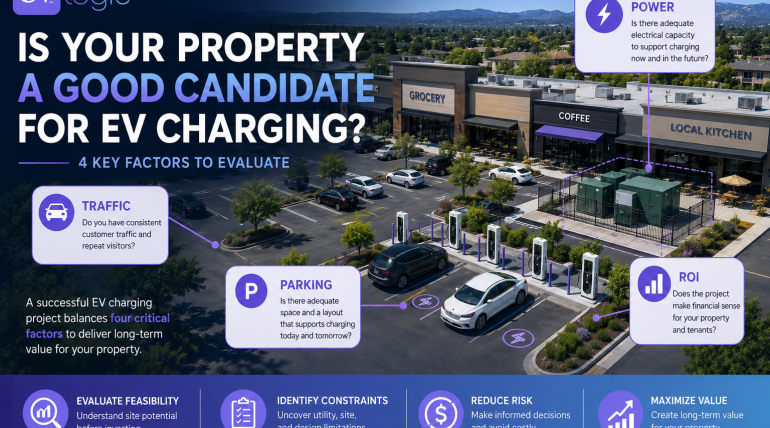
In reality, a good EV charging site depends on four factors:
- Customer behavior
- Electrical infrastructure
- Site layout
- Project economics
If you're evaluating EV charging for your property, here's where to start.
1. Do People Already Have a Reason to Visit?
The most successful charging locations usually have one thing in common:
People are already there.
Drivers rarely want to make a special trip just to charge. They prefer charging while doing something they were already planning to do.
Examples include:
- Grocery stores
- Shopping centers
- Restaurants
- Mixed-use developments
- Hotels
- Multifamily communities
- Fleet facilities
Ask yourself:
- How often do visitors return?
- How long do they stay?
- Are visits part of a routine?
A neighborhood shopping center with loyal weekly visitors may be a stronger charging candidate than a property with higher traffic but lower engagement.
Charging is increasingly becoming a convenience amenity rather than a destination.
2. Can the Site Support the Electrical Load?
A great location can quickly become a difficult project if electrical infrastructure isn't available.
This is often the first major hurdle for EV charging projects.
Questions worth investigating include:
- What utility service exists today?
- Is spare electrical capacity available?
- Is three-phase power available?
- Will service upgrades be required?
- How far is the nearest utility connection point?
Many property owners focus on chargers before understanding their electrical constraints.
The opposite approach is usually more effective.
Utilities often become the biggest driver of project cost and schedule. Understanding those limitations early helps avoid spending time on projects that may not be practical.
3. Does the Physical Layout Work?
Not every parking lot is easy to electrify.
Site layout has a direct impact on installation costs.
A few factors to evaluate include:
Distance to Electrical Equipment
The farther chargers are from switchgear or transformers, the more conduit, wire, trenching, and labor may be required.
Parking Configuration
Some parking layouts naturally support EV charging.
Others require extensive modifications.
Future Expansion
Many owners start with a small deployment and expand later.
Sites with room to grow often provide more flexibility as demand increases.
Accessibility Requirements
ADA compliance, vehicle circulation, and pedestrian access should all be considered early in the design process.
A property may have strong demand but poor constructability.
The best projects balance both.
4. Can the Economics Work?
This is where many property owners focus first, but it should usually come last.
Before calculating ROI, you need to understand whether the site is technically feasible.
Once feasibility is confirmed, consider where the value comes from.
For some properties, charging revenue will be important.
For others, the benefits are indirect.
Potential value drivers include:
- Increased customer traffic
- Longer dwell times
- Tenant retention
- Property differentiation
- Future asset value
One mistake owners make is evaluating charging solely through the lens of charger revenue.
In many retail environments, the additional spending generated by visitors may be more valuable than the charging session itself.
Don't Assume a Rejection Means the Site Won't Work
Many property owners speak with charging operators and receive a quick rejection.
That doesn't necessarily mean the site lacks potential.
Charging operators often evaluate sites based on their own business models, network expansion goals, and capital requirements.
Property owners have different objectives.
A site that doesn't fit a traditional charging network may still create significant value for tenants, customers, and the property itself.
That's why site evaluation should focus on the property's unique characteristics rather than a single operator's underwriting criteria.
The Best EV Charging Sites Balance Four Factors
There is no universal formula for EV charging success.
The strongest projects typically combine:
- Consistent customer demand
- Available electrical capacity
- A practical site layout
- Favorable economics
When those four elements align, EV charging can become a valuable long-term amenity and revenue opportunity.
The key is evaluating the site before making decisions about equipment, construction, or deployment strategies.
A proper EV charging feasibility study helps identify opportunities early, uncover constraints, and ensure capital is directed toward projects with the highest probability of success.
The question isn't whether EV charging is growing.
The question is whether your property is positioned to benefit from that growth.