How Much Does It Cost to Install a Commercial EV Charging Station?
Jun 04, 2026
How Much Does It Cost to Install a Commercial EV Charging Station?
Most property owners start by asking:
"How much does a DC fast charger cost?"
That's usually the wrong question. The charger itself is often not what determines whether a project moves forward.
We've seen projects with expensive chargers that were relatively straightforward to install. We've also seen projects where the electrical and utility work cost more than the charging equipment itself.
The better question is:
"What will it cost to install EV charging at my property?"
Because every site is different.
A project that works on one property can become financially unfeasible just a few miles away.
The Short Answer
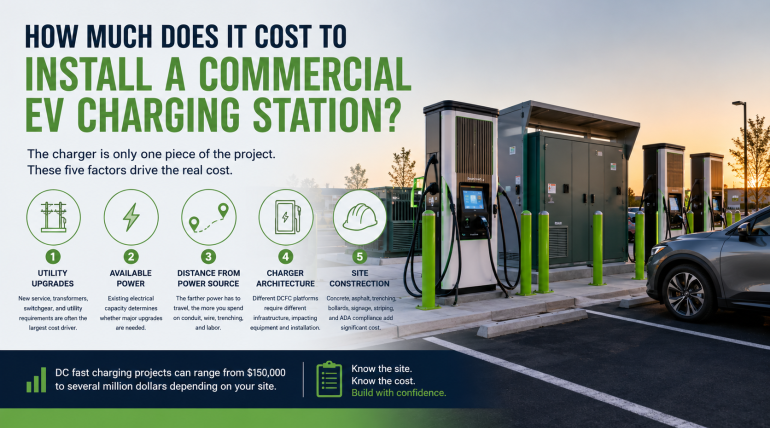
A commercial DC fast charging project can range from a few hundred thousand dollars to several million dollars depending on the site.
Here are some general benchmarks:
| Project Type | Typical Cost Range |
|---|---|
| 2-port DC fast charging site | $150,000 - $400,000 |
| 4-port public charging site | $400,000 - $1.2 million |
| 8-port highway charging plaza | $1 million - $3 million+ |
| Fleet charging depot | $500,000 - $5 million+ |
These numbers are directional only.
The same chargers installed at two different properties can produce dramatically different project costs. Why?
Because the charger is only one piece of the project.
The Five Biggest Factors That Drive EV Charging Costs
1. Utility Upgrades
In our experience, utilities are often the biggest source of cost uncertainty.
Many property owners assume power is available because the building already has electrical service.
That isn't always the case.
Depending on the charging load, a project may require:
- New utility service
- Transformer upgrades
- New switchgear
- Distribution system upgrades
- Utility engineering studies
In some cases, utility requirements add more cost than the charging equipment itself.
This is also where project timelines can expand significantly.
A site that looks attractive on paper can become difficult to justify once utility requirements are identified.
2. Available Electrical Capacity
Not all electrical services have enough capacity to support EV charging.
A retail center, warehouse, apartment complex, or fleet facility may already be utilizing much of its existing service.
Before selecting chargers, it's important to understand:
- Existing service size
- Available capacity
- Future load requirements
- Potential load management opportunities
Many projects become significantly more affordable when existing infrastructure can be utilized effectively.
Others require major upgrades before a single charger can be energized.
3. Distance From Power
Electricity has to travel from the source to the charger.
The farther away the chargers are located, the more expensive the installation becomes.
Additional distance increases:
- Conduit requirements
- Wire quantities
- Trenching
- Labor
- Surface restoration
A charger located 50 feet from electrical infrastructure can have a dramatically different installation cost than one located 500 feet away.
This is why site design matters.
Small layout decisions can have a major impact on project economics.
4. Charger Architecture
One of the most overlooked factors in EV infrastructure development is charger architecture.
No two DC fast charging platforms are engineered exactly the same way.
Some systems use integrated chargers.
Others use distributed power cabinets and dispensers.
Some support dynamic power sharing.
Others require dedicated power allocation.
These differences affect:
- Equipment count
- Electrical design
- Conduit runs
- Wire sizing
- Installation labor
Two charging systems with the same charging power can produce very different installation costs.
5. Site Construction
Many budgets focus heavily on electrical infrastructure while underestimating civil construction.
Common site costs include:
- Concrete demolition
- Asphalt cutting
- Trenching
- Surface restoration
- Bollards
- Signage
- Striping
- ADA improvements
These costs vary significantly by property.
An installation in an undeveloped lot looks very different from one being retrofitted into an existing retail center or fleet facility.
Why So Many EV Charging Projects Stall
One of the biggest challenges in EV infrastructure is that the true project cost often isn't discovered until months into the process.
The traditional development cycle typically involves:
- Site evaluations
- Utility coordination
- Engineering reviews
- Multiple design iterations
- Cost revisions
By the time all stakeholders understand the actual cost, the project may no longer meet financial expectations.
This is one reason so many EV charging projects never reach construction.
The issue usually isn't a lack of interest.
It's a lack of early visibility into feasibility and cost.
How Property Owners Should Evaluate EV Charging Opportunities
Before selecting equipment, property owners should answer five questions:
- How much electrical capacity is available today?
- Will utility upgrades be required?
- What charging experience am I trying to provide?
- Where should chargers be located on the property?
- What is the total installed cost, not just equipment cost?
The sooner those questions are answered, the easier it becomes to determine whether a project makes sense.
The Bottom Line
The biggest mistake property owners make is treating EV charging like equipment procurement.
It's infrastructure development.
The charger may be the most visible part of the project, but utility upgrades, electrical distribution, trenching, site design, and construction requirements are often what determine the final cost.
That's why experienced developers focus less on the price of the charger and more on the economics of the site.
Because in EV infrastructure, the question isn't:
"How much does the charger cost?"
It's:
"Can this site support a successful charging project?"