Accelerating DCFC Rollouts: Streamlining Utility Capacity Planning with EVlogic Software
Mar 03, 2026
Accelerating DCFC Rollouts: Streamlining Utility Capacity Planning with EVlogic Software
The electrification of transportation is no longer a distant vision; it's a rapidly accelerating reality. At the forefront of this transition is the critical need for robust Direct Current Fast Charging (DCFC) infrastructure. For charge point operators (CPOs), electric utilities, fleet managers, and real estate developers, deploying DCFC networks at an expedited pace is paramount to meeting escalating demand and supporting the growing number of electric vehicles (EVs).
However, the journey to a fully operational DCFC site is frequently fraught with complex and time-consuming challenges, particularly those related to utility capacity and interconnection. Unlike Level 2 charging, DCFC demands significant power, often requiring substantial and costly upgrades to existing grid infrastructure. These hurdles often lead to:
- Opaque Utility Data: Developers struggle to access precise, location-specific utility capacity information, leading to speculative site selection and design iterations that may prove unviable.
- Protracted Interconnection Queues: The process of utility studies, approvals, and physical interconnection can extend for months or even years, delaying project commissioning and revenue generation.
- Unforeseen Upgrade Costs: Unexpected requirements for new transformers, switchgear, or line extensions are frequently identified late in the development cycle, causing budget overruns and threatening project profitability.
- Complex Load Management: Accurately forecasting peak demand and managing electrical load to avoid punitive demand charges and ensure grid stability is a sophisticated task requiring specialized insights.
- Regulatory and Permitting Labyrinth: Navigating a fragmented landscape of local, state, and utility-specific regulations adds layers of complexity and potential delays.
These are not theoretical issues; they are real-world impediments that slow down the vital transition to electric mobility and impact the financial viability of charging network investments. Without a strategic, data-driven approach to utility engagement and capacity planning, DCFC projects risk becoming stalled assets rather than drivers of sustainable growth.
The EVlogic Solution: Data-Driven Utility Planning for Expedited DCFC Deployment
Founded by EV infrastructure pioneers with over 15 years of hands-on experience dating back to 2009, EVlogic understands these complex challenges intimately. Our specialized software platform is engineered to transform how professionals approach DCFC development, focusing specifically on demystifying and streamlining utility capacity planning and interconnection processes. EVlogic provides a single, integrated platform that empowers CPOs, utilities, logistics companies, commercial real estate professionals, and multifamily developers to make informed, data-driven decisions from the earliest stages of a project, significantly reducing cycle times and accelerating execution.
Here’s how EVlogic enables a smarter, faster DCFC deployment:
- Intelligent Feasibility Assessment with Utility Overlays: Our platform integrates extensive geospatial and utility grid data to perform rapid feasibility assessments. Users can instantly visualize available utility capacity at potential sites, identify nearby substations, and assess the potential impact of new DCFC loads on the local grid. This capability eliminates speculative site selection, ensuring that projects begin with a strong, utility-viable foundation, saving months of preliminary investigation.
- Accurate Rough Order of Magnitude (ROM) Pricing with Utility Upgrade Estimates: EVlogic generates precise ROM pricing that goes beyond just charging hardware and installation. Our proprietary database includes realistic cost estimates for utility service upgrades, new feeders, transformers, switchgear, and interconnection fees. This proactive cost estimation, typically within a +/-15-20% accuracy range for early-stage planning, allows for robust budget allocation and minimizes the financial surprises often associated with utility work, empowering decisions without costly contractor bid cycles.
- Proactive Utility Data Integration: We provide tools to integrate specific utility requirements and data points directly into the project plan. This includes understanding preferred interconnection points, specific application procedures, and typical study timelines for various jurisdictions. By providing this foresight, EVlogic helps users prepare comprehensive interconnection requests that are more likely to be processed efficiently, dramatically shortening utility review cycles.
- Optimized Power Configurations and Load Management: For high-power DCFC sites, our platform helps design optimized electrical configurations. It can simulate peak demand scenarios and propose intelligent load management strategies—potentially integrating energy storage or solar—to mitigate demand charges and ensure grid stability without overbuilding infrastructure. This data-driven approach balances energy requirements with cost efficiency and operational reliability.
- Streamlined Design-Build Documentation: From conceptual layouts to preliminary engineering drawings, EVlogic helps generate key documentation required for utility applications and early-stage permitting. This not only expedites the submission process but also ensures that designs are aligned with utility expectations from the outset, reducing costly revisions and project delays.
By providing these critical capabilities, EVlogic empowers development teams to approach utility engagement with confidence and precision, transforming what was once a major bottleneck into a manageable, accelerated phase of DCFC project delivery. This ensures that valuable capital is deployed efficiently and that critical charging assets are delivered on time and on budget.
Industry Impact: Empowering Expedited Electrification at Scale
The ability to accurately and efficiently navigate utility capacity and interconnection challenges has a profound and positive impact across the entire EV infrastructure ecosystem:
- For Charge Point Operators (CPOs): Achieve an expedited pace in network expansion, reducing time-to-revenue for new DCFC sites. Make strategic investment decisions backed by solid utility data, ensuring that capital is deployed to projects with the highest probability of timely and cost-effective interconnection. Scale operations with predictable development timelines, from pilot projects to large-scale deployments.
- For Utilities: Receive more mature, well-planned interconnection requests from developers, streamlining internal review processes and reducing the burden of speculative applications. Better anticipate and plan for the increasing demand of DCFC loads on the grid, informing crucial infrastructure upgrades and long-term capital planning.
- For Fleet Operators & Logistics Companies: Gain greater certainty in deploying high-power DCFC for vehicle electrification, enabling timely transitions to EV fleets without operational disruptions due to charging infrastructure delays. Optimize depot charging designs to meet demanding operational schedules and minimize energy costs effectively.
- For Commercial Real Estate Professionals: Accelerate the deployment of valuable DCFC amenities, attracting EV-driving tenants and customers, thereby increasing property value and competitiveness. Mitigate risks associated with property development by proactively addressing utility constraints, protecting project timelines and budgets.
- For Multifamily Property Developers: Provide essential EV charging infrastructure to residents more quickly and cost-effectively, meeting market demand and enhancing property appeal, all while navigating complex utility requirements.
EVlogic is more than a software platform; it's a strategic tool that instills confidence and efficiency in the complex world of DCFC infrastructure development, ensuring that critical charging assets are delivered on time and on budget to meet the surging demands of the electric future.
Technical Details: The EVlogic Engine for Utility & Interconnection Mastery
The technical foundation of EVlogic’s platform is built upon deep industry knowledge, sophisticated data analytics, and real-world project experience. Our tools provide an unparalleled level of detail and foresight for DCFC development:
- Proprietary Utility Data Aggregation: We continuously aggregate and update comprehensive utility data across numerous service territories. This includes, but is not limited to, substation locations, feeder capacities, voltage levels, tariff structures, and specific interconnection requirements (e.g., studies required for certain load sizes). This living database provides instant, granular insights that are critical for high-power DCFC applications, helping to identify optimal sites quickly.
- Automated Impact Analysis: When a user places a proposed DCFC installation on a site within the platform, EVlogic’s engine automatically performs an initial impact analysis. This includes estimating the load impact on the nearest utility infrastructure and flagging potential areas where capacity constraints or significant upgrades might be required. This "pre-screening" identifies red flags and potential project challenges long before formal utility engagement, saving significant time and resources.
- Dynamic ROM Cost Modeling for Grid Upgrades: Our ROM pricing engine incorporates a sophisticated model for estimating utility upgrade costs. This model considers factors such as the required kVA increase, distance to the nearest suitable utility infrastructure, the need for new transformers or switchgear, and estimated labor and material costs specific to utility construction. It provides an estimate for both utility-led and customer-side upgrades, offering a holistic financial projection.
- Vetted Product Library and Compatibility: EVlogic integrates a comprehensive library of vetted DCFC charging stations, electrical panels, switchgear, and other critical components. The platform ensures compatibility, adherence to industry standards, and provides real-time pricing data, allowing developers to design with confidence and avoid costly re-specifications.
- Scalable Development Planning: The platform supports planning for phased deployments, allowing CPOs and fleet operators to strategically scale their infrastructure. It helps model the impact of future expansion on utility capacity and costs, providing a clear roadmap from pilot projects to extensive network rollouts.
Case Study: Expediting a National Fleet Electrification Program
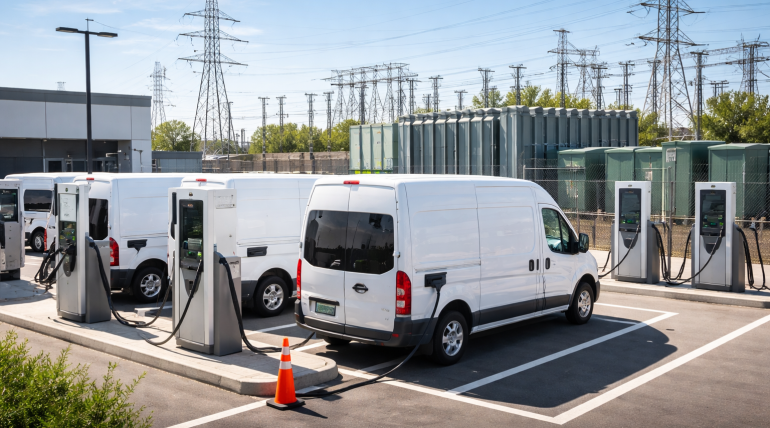
Consider a national logistics company committed to electrifying its medium-duty delivery fleet across 20 major distribution centers. Initially, their internal team faced significant hurdles: each site fell under a different utility jurisdiction with varying requirements, and obtaining reliable capacity information was a slow, manual process. Initial estimates for utility upgrades varied wildly, creating budget uncertainty and threatening the entire rollout timeline.
By leveraging EVlogic's platform, the logistics company drastically streamlined its feasibility and planning phase. Within weeks, they utilized EVlogic's utility overlays to assess initial capacity at all 20 sites. The platform's automated impact analysis immediately identified 5 sites with significant utility constraints, allowing the team to either re-evaluate site selection or proactively budget for major upgrades. EVlogic's ROM pricing generated accurate, data-driven cost estimates for utility interconnection and upgrades for all locations, providing a clear financial picture within a +/-18% margin of the final engineering estimates. This upfront intelligence allowed them to prioritize sites, refine their budget, and engage utilities with well-prepared documentation. The overall initial feasibility and planning phase, which was projected to take 8-12 months, was reduced to just 3 months, accelerating their fleet electrification program by over 60%.
This pragmatic application of EVlogic's tools translated directly into faster project initiation, reduced financial risk, and a significantly accelerated path to operational electric fleets.
Ready to Accelerate Your DCFC Deployment Strategy?
Stop letting utility complexities dictate your EV charging project timelines. EVlogic provides the data intelligence and planning tools you need to overcome these challenges, streamline your development process, and accelerate your DCFC rollouts. Our platform empowers you to make confident, data-driven decisions that translate into faster project delivery and a more robust EV charging network.
Schedule a Platform Walkthrough today to see how EVlogic can transform your next DCFC project.
Frequently Asked Questions About DCFC Utility Planning
Q1: How does EVlogic specifically address utility interconnection delays for DCFC projects?
A1: EVlogic tackles interconnection delays by providing proactive, data-driven insights. Our platform offers early visibility into utility capacity, potential upgrade requirements, and specific utility application procedures. This allows developers to submit more comprehensive and accurate interconnection requests, significantly reducing back-and-forth communication and shortening the utility's review and approval timelines. By identifying red flags early, costly revisions and project pauses are minimized.
Q2: What level of accuracy can I expect from EVlogic's ROM pricing for utility upgrades?
A2: Our Rough Order of Magnitude (ROM) pricing for utility upgrades is designed for early-stage planning and typically achieves an accuracy range of +/-15-20%. This is significantly more precise than traditional estimates based on limited information. EVlogic's proprietary algorithms and extensive database factor in specific utility tariffs, equipment costs, and regional labor rates to provide realistic, actionable cost projections, empowering better financial planning.
Q3: Can EVlogic help with both DCFC and Level 2 charging projects, particularly regarding utility planning?
A3: Yes, EVlogic's platform is designed to support the planning and deployment of both DCFC and Level 2 charging infrastructure. While DCFC projects often present more substantial utility challenges due to higher power demands, our tools for feasibility assessment, ROM pricing, and utility data integration are equally valuable for Level 2 projects, ensuring optimal electrical design and cost efficiency across all charging types.
Q4: How does EVlogic integrate with existing project management or design processes?
A4: EVlogic is designed to enhance existing workflows rather than replace them. Our platform serves as a powerful front-end planning and feasibility tool that generates critical data, reports, and preliminary designs. This output can then be seamlessly integrated into your preferred project management software, engineering design tools, or shared with contractors, ensuring a smoother transition from conceptualization to detailed design and construction.
Q5: Is EVlogic suitable for small-scale pilot projects as well as large, multi-site deployments?
A5: Absolutely. EVlogic's scalability is one of its core strengths. Whether you're planning a single DCFC installation as a pilot project or orchestrating a large-scale, multi-state network expansion for a fleet or CPO, our platform provides the same level of data-driven insight and efficiency. It helps ensure that even small projects are built on a solid foundation, while offering the robust planning capabilities needed to manage the complexity of hundreds or thousands of charging sites.